
How the damage actually happens
Bamboo does not drill through concrete, and it is worth being straight about that, because overstating it is how the internet has ended up frightening people about a manageable garden problem.
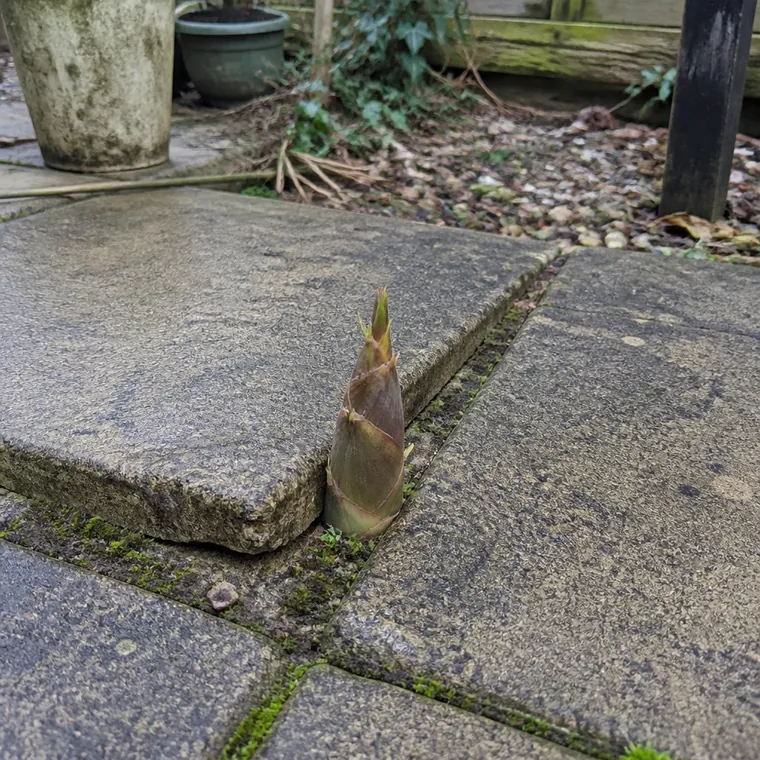
What a bamboo shoot does have is real mechanical force in a very small area. A new shoot emerges as a hard, pointed spear and pushes upward with enough power to lift what is above it. Give it an existing crack, a mortar joint, a slab edge, a gap between decking boards or a soft patch of tarmac and it will come up through it, widening the gap as it goes.
The rhizomes themselves work differently. They travel horizontally through loose topsoil, following the path of least resistance — which frequently means along a foundation, under a slab, or beside a drain trench where the backfill is softer than the surrounding ground. They do not create the void; they use it, and then thicken inside it.
What's actually at risk
The pattern across all of these is the same: bamboo finds weaknesses. Sound, well-maintained hard landscaping is far more resistant than anything already cracked or ageing.
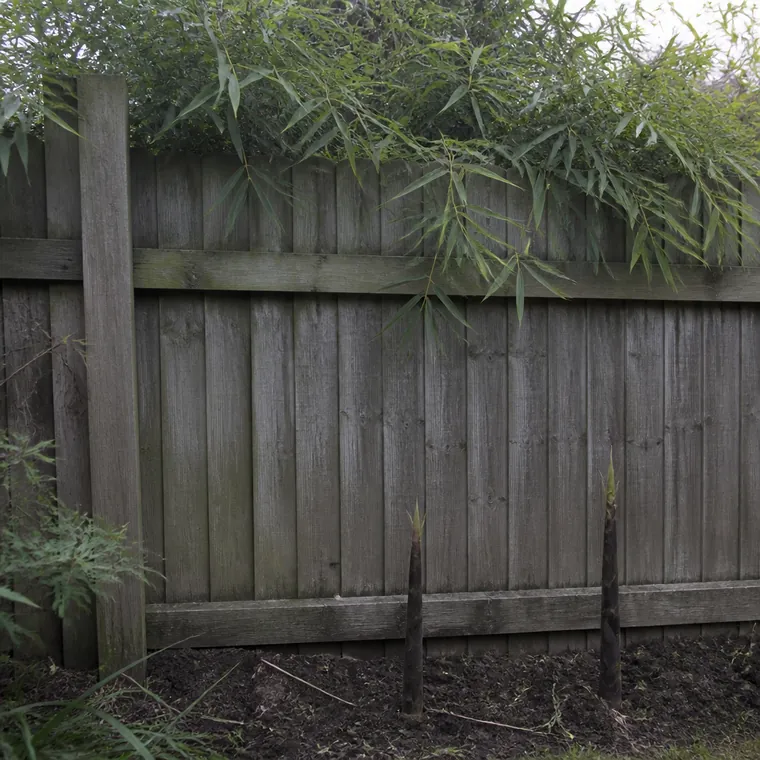
What it looks like when it happens
What to check in your own garden
Ten minutes with a torch, ideally in late spring when new shoots are up.
- ✓New shoots coming up away from the main clump — the single most important sign, and the one that tells you it is a running type.
- ✓Shoots or lifting at paving and slab joints, especially the joints nearest the bamboo.
- ✓Cracking or humping in a drive or path on the bamboo side.
- ✓Canes appearing through or under a fence line, in either direction.
- ✓Shoots inside a cavity, against airbricks, or under decking where bamboo is planted close to the house.
- ✓Anything coming up in a drain inspection chamber, or slow drainage that has appeared since the bamboo established.
- ✓How close the clump is to anything you would mind lifting — distance from hard landscaping is the best predictor of trouble.
Do not simply cut the shoot off and re-point the joint. The rhizome that produced it is still there, still under the slab, and it will send up another.
Get the extent established before you repair anything, because the repair sequence matters: dealing with the rhizome first and the paving second saves doing the paving twice.
Frequently asked questions
Can bamboo grow through concrete?
Not through sound, intact concrete. It exploits what is already there — expansion joints, cracks, edges, and the softer material around them.
Which in practice looks a lot like growing through concrete, because most domestic paving and slabs have plenty of joints and hairline cracks. A shoot coming up through a patio has found a gap; it has not manufactured one.
How far from my house should I plant bamboo?
For a clumping type, treat it like any other large shrub — a couple of metres from the wall is comfortable.
For a running type, distance alone will not save you: the rhizomes travel metres, so “far enough away” is not a realistic strategy in a domestic garden. The answer is a root barrier at planting, or a clumping species instead. If you already have a running bamboo close to the house, that is the situation most worth getting looked at.
Will bamboo get into my drains?
It can, but usually only where a drain is already compromised. Rhizomes and roots exploit failing joints and existing cracks, which is exactly how tree roots get into drains too; sound modern plastic pipework with sealed joints is much less vulnerable.
The tell-tale is drainage that has got slower since the bamboo established, or growth appearing in an inspection chamber. If you suspect it, a drain survey and a bamboo assessment are worth doing together, because the repair order matters.
Does bamboo damage matter for a mortgage or a survey?
Bamboo does not carry the standard lender requirements that Japanese knotweed does, and it is not generally a mortgage blocker.
A surveyor who sees bamboo tight against the house, or lifting a patio, will comment on it — as they would with any vegetation causing damage. That comment becomes a negotiating point for a buyer rather than a barrier to lending, which is why dealing with it before you market is usually cheaper than discussing it afterwards.